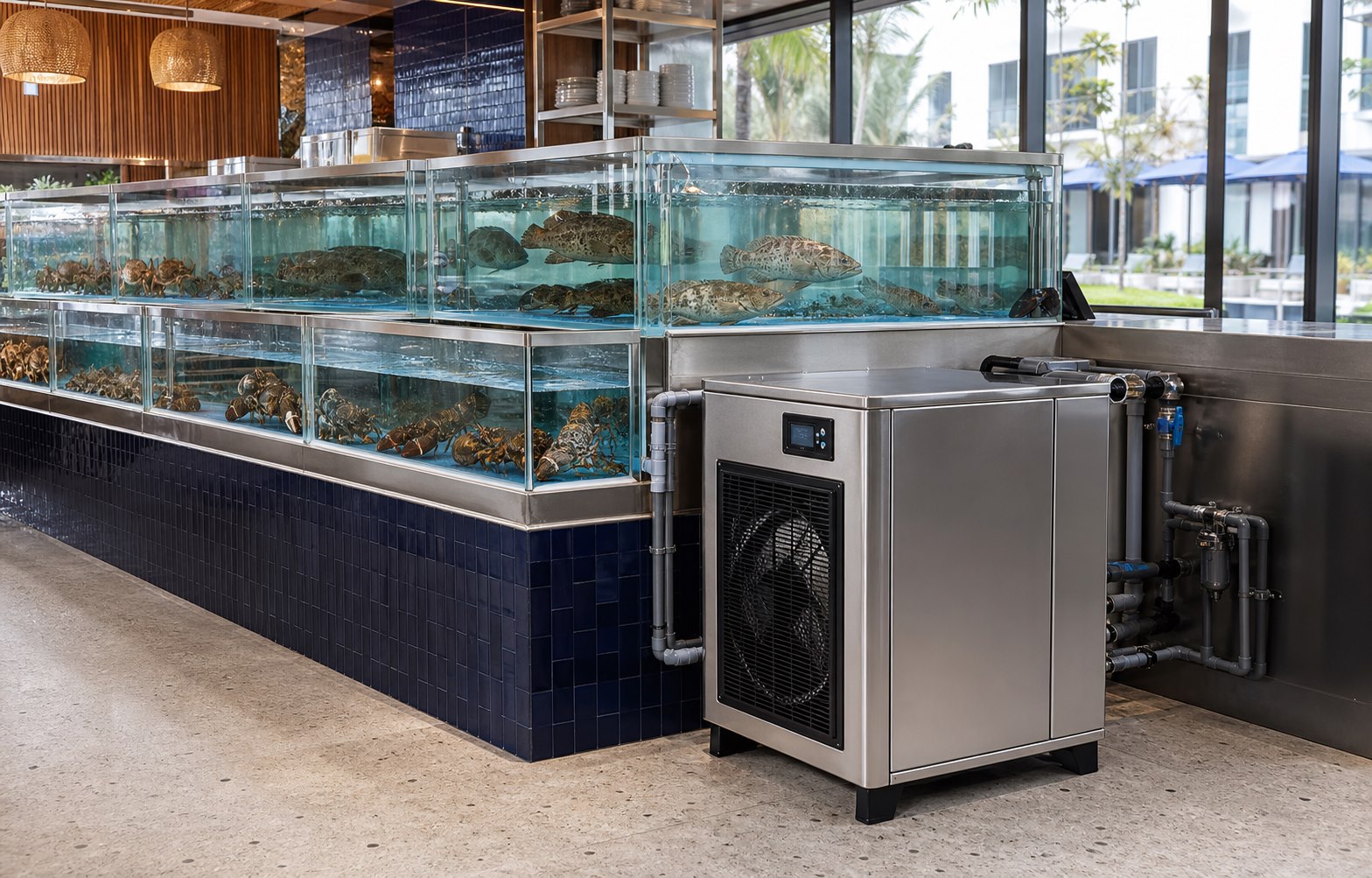
A 500L lobster tank in an air-conditioned indoor space usually starts with a 1.5HP chiller. A 1,000L tank under tropical ambient air typically starts with a 2HP. A 2,000L tank in a humid market or wholesale facility usually starts with a 3HP. Always recheck against target temperature, seafood loading, insulation and pump heat before final selection.
Why tank size alone is not enough
Many operators first ask: what HP do I need for a 1,000L lobster tank? Tank water volume is only the starting point. Target water temperature, ambient air temperature, tank insulation, pump heat, display lighting, daily seafood loading and required pull-down time all change the cooling load. A 1,000L lobster tank in a cool air-conditioned Hong Kong restaurant is different from a 1,000L tank in a humid Singapore market stall, and both are different from a 1,000L holding tank in a Malaysia wholesale facility.
Sizing rule of thumb for lobster tanks
For tropical operating conditions (28°-34°C ambient), the table below gives a practical starting point. Final selection should be reviewed against the engineering checklist further down.
| Tank volume | Typical chiller model | Real operating conditions |
|---|---|---|
| 500L | 1.5HP inverter seafood tank chiller | Small display tank, one species, indoor restaurant or hotel back-bar counter |
| 1,000L | 2HP inverter seafood tank chiller | Mid-size restaurant display, market stall with moderate turnover, lobster plus crab in a mixed tank |
| 2,000L | 3HP inverter seafood tank chiller | Wholesale holding, large market tank, hotel live seafood display, multi-tank circulation loop |
Real commercial conditions in Singapore, Hong Kong and Malaysia
Singapore seafood markets. Ambient temperatures of 29°-34°C and high humidity are typical. Stall operators run from early morning to late evening, and display tanks often hold several species together. A 12°-16°C target water temperature is common for live lobster display. Pull-down should be quick so newly arrived stock settles fast.
Hong Kong seafood restaurants. Restaurant lobster tanks are mostly placed indoors with strong air conditioning, but compact machine rooms and dinner-service heat gain push ambient up quickly. Restaurant tanks usually run 16°-18°C. Noise matters because the chiller is often close to the dining area.
Malaysia wholesale and holding facilities. Larger holding tanks of 2,000L or more are common across Pasir Gudang, Sabah and Sarawak seafood supply chains. These systems often run 24 hours, so inverter control and easy maintenance access become important.
Engineering checklist before final selection
- Real water volume in litres, not just tank length
- Target water temperature for the species (lobster, crab, grouper)
- Highest expected ambient air temperature
- Daily seafood loading and turnover pattern
- Saltwater, brackish or freshwater
- Pump flow rate and pump heat contribution
- Tank lid, insulation and direct sunlight exposure
- Power supply voltage and phase
- Maintenance clearance around the chiller
Why titanium matters for lobster tanks
Lobster systems run on saltwater or close-to-sea salinity. The water-side heat exchanger should be titanium so the cooling circuit stays protected from corrosion. This is one of the common reasons lobster tank chillers fail early in tropical climates — the heat exchanger material is not matched to the water type.
Frequently asked questions
Can a 1.5HP chiller handle a 1,000L lobster tank?
Usually not under tropical ambient conditions. A 1.5HP unit is engineered for tanks around 500L when the target temperature is several degrees below room temperature. At 1,000L the chiller can run continuously and struggle to recover when fresh stock is loaded. A 2HP is the safer starting point for 1,000L lobster tanks.
Do I need a bigger chiller if the restaurant is near a hot kitchen?
Yes. Hot kitchen exhaust and indoor ambient temperature both add heat to the tank room. Operators should add 10°-20% capacity reserve if the chiller is installed in a poorly ventilated machine room or close to the kitchen.
Is inverter really necessary for lobster tanks?
Lobster tanks run for long hours and target a narrow temperature band. Inverter control follows the actual cooling load, reduces temperature swings and can lower electricity use during quiet periods compared with a fixed-speed unit that cycles at full power.
What information should I send for a quotation?
Tank dimensions, real water volume, target temperature, ambient temperature, water type (freshwater, brackish, or saltwater), seafood species, daily loading pattern and a few photos of the installation space. The more accurate the input, the more accurate the configuration recommendation.
Summary
Tropical climate lobster tank sizing is not only about litres. Combine tank volume, target temperature, ambient air, seafood loading, water type and pump flow before selecting 1.5HP, 2HP or 3HP. For 500L start with 1.5HP. For 1,000L start with 2HP. For 2,000L and above start with 3HP, especially in Singapore market stalls, Hong Kong hotel seafood displays and Malaysia wholesale holding facilities.