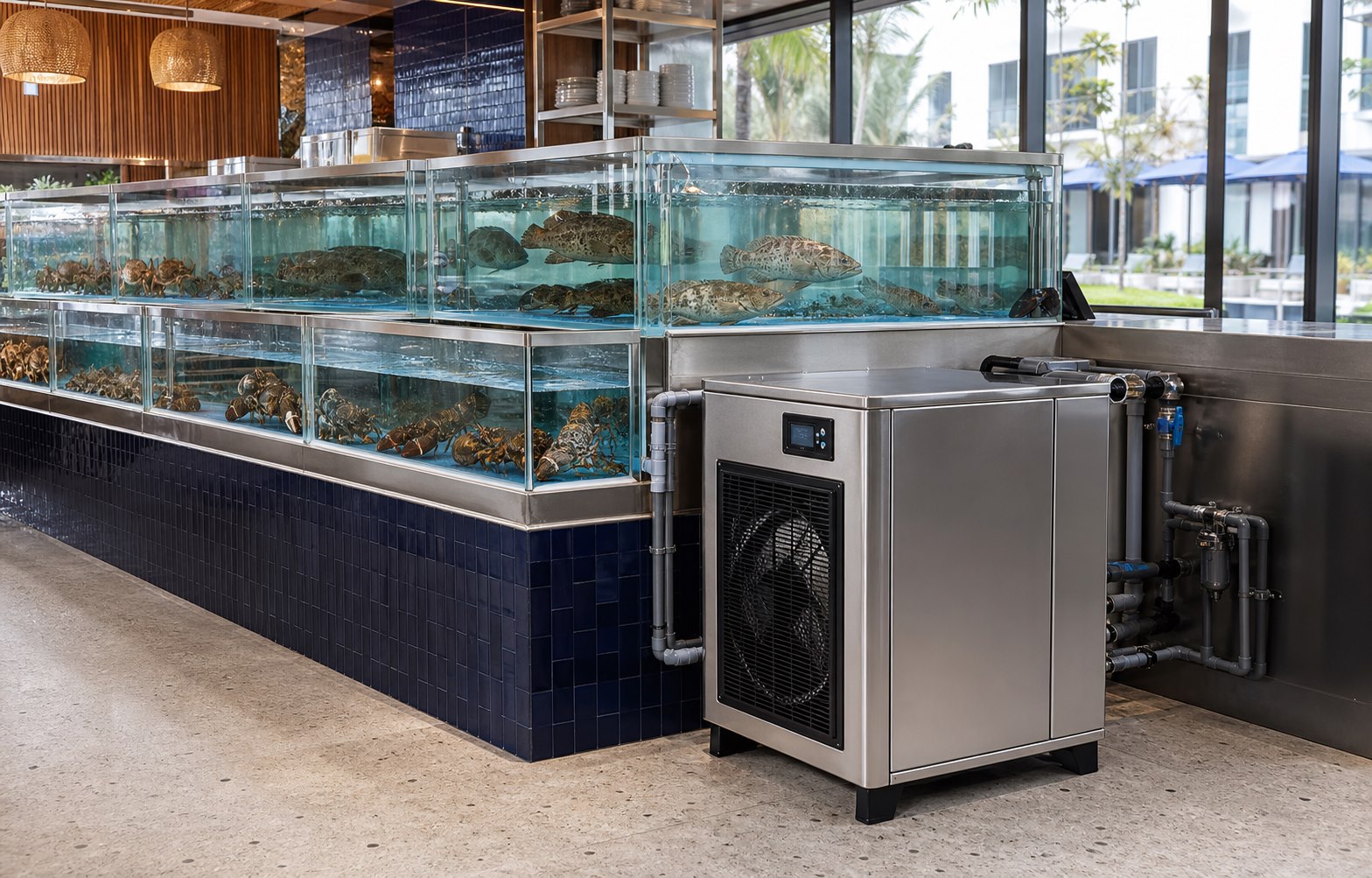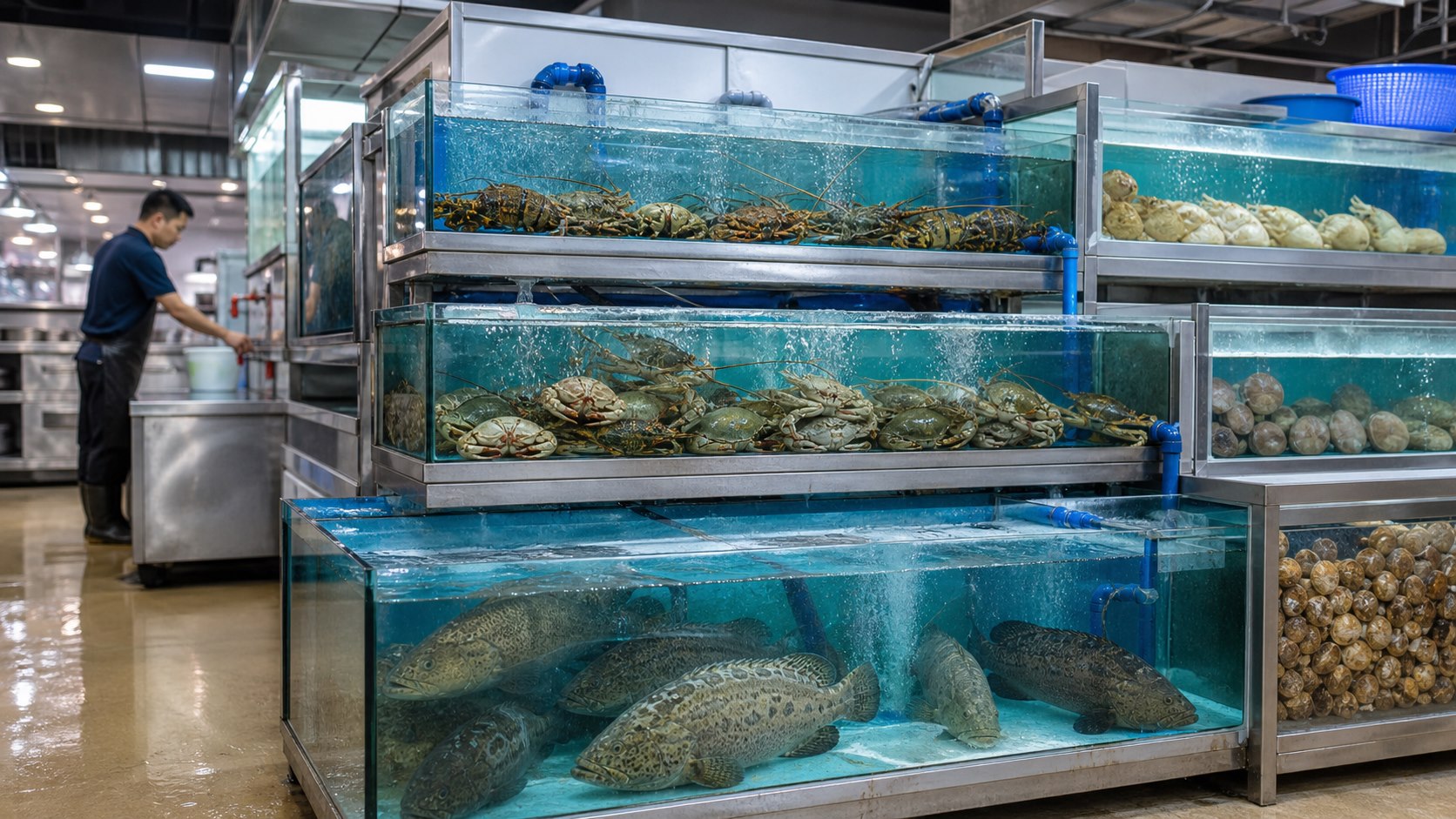
Reliable temperature control for wholesale holding, transport preparation and live fish logistics. The right system combines inverter capacity control, titanium water-side materials and accurate sensors sized to the actual tank load.
Common operating challenges
- Rapid loading changes
- Stress from temperature fluctuation
- Long holding periods
- Limited service windows
- Need for reliable alarms
Recommended system configuration
We calculate capacity from water volume, target temperature, ambient heat, livestock load, pump heat and tank exposure. The standard configuration includes an inverter compressor, titanium heat exchanger, digital controller and saltwater-compatible circulation loop.
| Water volume | Typical cooling range | Recommended configuration |
|---|---|---|
| 1,000–3,000 L | 3–6 kW | Compact inverter unit |
| 3,000–8,000 L | 6–15 kW | Commercial inverter unit |
| 8,000–20,000 L | 15–35 kW | Dual-loop or modular system |
| 20,000 L+ | Project calculation | Custom central system |
Inverter vs fixed-speed chiller
| Item | Inverter chiller | Traditional chiller |
|---|---|---|
| Capacity control | Continuously modulated | On / off cycling |
| Water temperature | More stable | Larger fluctuation |
| Energy use | Follows actual load | Higher cycling losses |
| Noise | Lower at partial load | Frequent start noise |
Frequently asked questions
How is chiller capacity selected?
Capacity is based on water volume, temperature pull-down, ambient temperature, tank insulation, circulation equipment and seafood load.
Why use a titanium heat exchanger?
Titanium provides strong corrosion resistance on the saltwater side and supports long service life in marine applications.
Can the system run continuously?
Yes. The equipment is configured for continuous commercial duty when installed with correct water flow, ventilation and maintenance access.